English translation below
Je kunt alles nog zo goed voorbereid hebben, je bent nooit
voorbereid op een eerste bezoek aan Afrika. Daar kom je achter als je het
vliegtuig uitstapt en de vochtige, overweldigende hitte je in het gezicht
slaat, terwijl het pas half 5 ‘s morgens is. Wanneer je je handen moet wassen
voordat je het vliegveld binnenloopt, want ebola. En wanneer je chauffeur, als
je tegen hem zegt dat je nooit zo’n zwarte nacht hebt gezien, vraagt of het
over de lucht gaat of over zijn huidskleur.
Zo kwam ik aan in Liberia. De Nigeriaanse Mineke Foundation-teamcoördinator
Bukola - Bukky – en haar man Ayo staan me op te wachten. Welkom in het echte
Afrika, zegt hij.
Het laatste stuk van de weg naar huis zit vol gaten. Het
heeft geregend, sommige staan onder water. ‘Kijk wat een prachtige weg,’
verzucht Bukky, terwijl ze de auto voorzichtig langs de gaten manoeuvreert.
Bukky woont in Bardnersville, een buitenwijk van Monrovia. Als
er zoiets bestaat als een cultuurschok, krijg ik hem nu. Niet dat er nu zoiets
engs of raars aan de hand is. Helemaal niet. Bukky’s huis is in vrolijk geel en
groen geverfd, er komt een lachend bloot jongetje naar buiten gerend. Verderop
loopt een vrouw in een gekleurd Vlisco-achtig gewaad met een mand op haar hoofd.
Tussen de huisjes groeit weelderig tropisch groen. Het is helemaal niet eng, maar het is zo écht. Het is geen
stereotype uit een koffietafelboek van een wereldmuziekliefhebber, het is echt.
Het blote jongetje is Bukky’s zoontje Daniel van bijna twee.
Hij is helemaal niet verlegen, en sleept me meteen het huis door om het te
laten zien. Mijn kamer, sober maar fijn. De huiskamer, ruim en met een
televisie. De kleine keuken met gasfornuis.
Bukky is geduldig en legt me alles uit. Je vult de emmer met
de ton en gaat in de douchecabine staan om je te wassen. Ja, zo vaak je wil. En
ja, het is hier veilig. Geen zorgen.
Ze neemt me mee naar het MF-kantoor, een paar minuten lopen
vanaf haar huis. Onderweg stelt ze me voor aan buren. Welcome to Liberia.
Relax, wen aan de hitte.

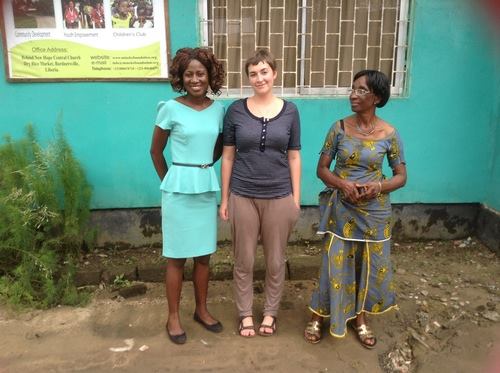
Het ruime kantoor is groen, net als Bukky’s huis. Ik ontmoet
projectleider Mary en assistent Emma. Bukky laat me de bakkerij zien en stelt
me voor aan de vrouwen van de zeepmaak-club, die net klaar zijn met hun les.
’s Middags halen we Ayo op van zijn werk in de wijk Sinkor. Overal
langs de weg staan kraampjes en lopen mensen. Overal klinkt muziek. Onderweg
zetten we Mary af, zij moet nog een stuk reizen naar haar huis.
Het verkeer staat zoals altijd flink vast. Onderweg stoppen gedeelde
taxi’s om mensen in en uit te laten. Veel mensen staan te liften, minibusjes en
trucks zitten overvol gepropt. Langs de files verkopen jongens en meisjes
snoepjes, water en brood. ‘This too is Liberia’, herhaalt Ayo bij elke
bijna-aanrijding.
Het is donker en het regent als we thuiskomen. Ayo brengt de
auto naar het MF-kantoor, dat ’s nachts beveiligd wordt. ‘Anders is onze accu
morgenochtend weg,’ legt Bukky uit.
Vrijdag, 6 uur ’s morgens. Ik word wakker van kraaiende
hanen, potten en pannen in de keuken en Daniels lach. Bukky gaat naar kantoor
nadat ze Daniel naar school heeft gebracht, ik volg rond half 9. Mijn eerste
werkdag.
Taakje één is het zoeken van foto’s van verschillende beroepen
voor de Kids Club. De kinderen moeten daar uitleg bij geven. Ineens realiseer
ik me dat je alleen maar witte mensen te zien krijgt als je generieke termen als
‘teacher’ op Google invoert.
De stroomt val uit. Jammer, want daardoor stopt de
ventilator, maar ook omdat mijn zoektocht naar afbeeldingen nu zinloos was – de
projector doet het niet. Zo leer ik al snel dat je in Liberia vaak je manier
van werken moet aanpassen aan de omgeving, in plaats van andersom. Dat
betekent: iets anders doen.
De Kids Club, in dit geval. De kinderen arriveren na school,
die op vrijdag vroeg uit is. De vrijwilligers leggen uit dat je, wanneer je
geld wil verdienen met een beroep, je het goed onder de knie moet krijgen. Dat
is althans wat ik ervan versta – Liberiaans-Engels klinkt minder Engels dan
de naam suggereert.
Ondertussen worden liedjes gezongen om de aandacht erbij te houden.
Dat is nodig, want veel kinderen kunnen zich na school slecht concentreren. Eerder
kwamen er meer dan 60 kinderen op de club af, nu nog zo’n 25. Daarom hebben ze in
november een sportcompetitie georganiseerd tegen een school in de buurt. De
jongens spelen voetbal, de meisjes kickball, een aangepaste – onbegrijpelijke -
vorm daarvan.
Elke vrijdagmiddag trainen ze, in de hoop meer kinderen naar
de club te krijgen. Ook nu staan de kinderen te popelen. Eerst moeten ze zich aan
mij voorstellen, wat ze heel spannend vinden. Geeft niet, ze krijgen genoeg
tijd om aan me te wennen.

De kinderen oefenen op een open plek tussen de huizen.
Ondanks de hitte zijn ze fanatiek, net als de omwonende moeders. Wanneer eentje
op de scheids begint te schelden lijkt het wel een doodgewone Nederlandse
zaterdag langs de lijn van de plaatselijke jeugdvoetbalclub.
Zaterdag neemt Bukky me mee naar Dabwe Town, een kwartiertje
lopen vanaf hier. Het lijkt op onze community, maar is ruimer opgezet en wat
rustiger. Sommige deelnemers van de vakopleidingen komen hiervandaan. Tonia’s
vader, Dabwe Wiah, woont hier naast de Damiefa school, die hij in 1982 heeft
opgericht maar die niet operationeel meer is.
Dabwe staat in zijn deuropening met ontbloot bovenlijf. Hij
is klein en slank, voor zijn 85 jaar oogt hij sterk. Hij heeft een warme
glimlach, die hij vaak laat zien. Als hij hoort waar ik vandaan komt verwelkomt
hij me in het Nederlands, wat hij nog steeds spreekt.

Dabwe laat me de school zien. In de tuin verbouwt hij rijst,
en hij werkt aan het gebouw dat niet meer in goede staat is. Het dak lekt, een
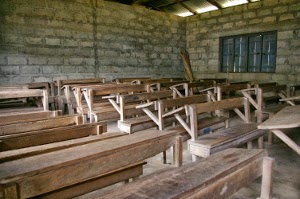
aantal bankjes zijn stuk. ‘De poten zijn als brandhout gebruikt’, zegt hij
hoofdschuddend. In het auditorium, dat eerder met behulp van MF is opgeknapt, wijst
hij aan wat er fout is gegaan bij de reconstructie, omdat de werkers niet naar
hem luisterden. Hij kan zijn levenswerk moeilijk loslaten.

Intussen heeft Jonathan, een inwonende vriend van Bukky, me een
paar keer op sleeptouw genomen door de omgeving. Ik heb zelfs achterop een
motorcycle gezeten – die worden als taxi’s ingezet, maar zijn veel sneller
omdat ze langs het drukke verkeer kunnen rijden. Volgens Bukky kan ik nu pas
zeggen dat ik écht in Afrika ben. Verder kan Jonathan veel van mijn vragen
beantwoorden over de geschiedenis en de politiek van Liberia.
Maandag bespreken Bukky en ik mijn taken. Ik ga helpen met
de logistiek omtrent de lancering van MF Liberia en de diploma-uitreiking van
de deelnemers van de vakopleidingen in december. Ik ga de vrijwilligers van de
Kids Club, de trainers van de zeep- en bakkersopleiding en de medewerkers
observeren en bespreken wat beter kan. Aan de hand van notities van de trainers
zal ik een handboek opstellen voor de vakopleidingen en Bukky ondersteunen bij
het opstellen van medewerkerevaluaties. Ten slotte ga ik met Roos, die in
november komt, een bijeenkomst van de Women’s Club voorzitten, over het managen
van je huishoudboekje.
Bukky en ik gaan aan de slag met het adresseren en
rondbrengen van uitnodigingen voor de lancering en de diploma-uitreiking. De
post is hier niet te vertrouwen, en e-mail wordt snel genegeerd, dus bij het
uitnodigingen van belangrijke gasten moeten we ons gezicht laten zien. Rond een
uur of 11 vertrekken we richting de stad. Als we de brug over de Mesurado
rivier overrijden zie ik aan de waterkant allerlei golfplaten hutjes: West
Point, de sloppenwijk van Monrovia, die tijdens de Ebolacrisis een tijdje ‘op
slot’ is gezet tot woede van de inwoners.
We rijden door de drukke Waterside Market, waar (veelal tweedehands)
kleding tot kantoorartikelen verkrijgbaar zijn, Mamba Point in, een wijk waar
veel ambassades en ngo’s huizen. Het contrast met waar we vandaan komen is
enorm: mooie grote huizen, beveiligd, iedereen ziet er piekfijn uit. We droppen
de uitnodigingen bij verschillende ministeries. De minister van Gender belooft
als keynote speaker op te treden tijdens de lancering. Bukky is blij, maar ze
weet ook dat het niet betekent dat ze ook echt komt: dat heeft ze al eerder
meegemaakt bij de spellingwedstrijd van de Kids Club.
Het is ondertussen vreselijk heet en de auto lijkt wel een
oven. Nadat we nog een paar uitnodigingen hebben afgeleverd, rusten we even uit
op Golden Beach. Het is een strand uit de boekjes: palmbomen, schoon zand, een
heerlijk briesje. Er is bijna niemand. Na een uurtje, én het gebruik van een
toilet met stromend water bij de Beach Club, ben ik weer helemaal opgeladen.

Deze dag bevestigt waar ik al eerder achter was: je moet je aanpassen
aan de omgeving, andersom gaat niet. We zijn van 8 uur ’s morgens tot half 8 ’s
avonds bezig geweest, we zijn kapot, en we hebben maar zo’n 20 uitnodigingen
uitgedeeld. Kortom, je werkt hard maar kunt niet veel werk verzetten.
Dinsdag laat Mary me de zepen zien die hier gemaakt worden. De
cursisten kunnen door hen gemaakte zeep voor een schappelijke prijs overnemen
van MF, zodat de kosten van de stichting gedekt zijn, en dan doorverkopen.
Vorige week kwamen meermaals cursisten langs ons huis om zeep te verkopen en
cakejes, voor Bukky een teken dat het
werkt. Sommige cursisten reizen meer dan een uur om de opleidingen te kunnen
volgen.
Mary vertelt me over de moeilijkheden die Mineke Foundation
ervaart. De trainers verstaan hun vak wel, maar zijn niet opgeleid om het over
te brengen: veel mensen hebben geleerd zeep, brood of tie-dye te maken in de
VN-kampen na de oorlog.
Ook het mobiliseren van jongeren is lastig. Dabwe Town laat
het de laatste tijd een beetje afweten, vertelt Mary. Door de omliggende
communities te mobiliseren hopen ze Dabwe Town te laten zien wat meedoen
oplevert.
Volgens Mary moet juist de jeugd verandering teweeg brengen
in Liberia. Zij hebben de kans, er is vrede, er is internet. ‘We hebben al deze
rijkdommen, maar we kunnen er niet de vruchten van plukken. Omdat we daar niet
klaar voor zijn’, zegt Mary. Ik denk aan hoe Bukky me er laatst op wees hoeveel
jongeren op straat in hun schooltenue slenteren. Ze verlaten ’s morgens het huis,
maar gaan niet naar school.
’s Middags kijk ik met Bukky mee met de bak-cursisten.


Leven van dag tot dag, niet denken aan morgen. Dat is volgens
Ayo de Liberiaanse mentaliteit. Daarom kopen ze bijvoorbeeld iedere dag een
portie rijst op de markt, terwijl het veel goedkoper zou zijn om eens per maand
een enorme zak bij de groothandel te halen.
En daarom, zegt hij, werken er zoveel niet-Liberianen in de
kantoren. Liberianen, die vanwege het slechte onderwijs de banen zelf niet
kunnen vervullen, zijn daar boos over, maar willen niet leren van de
buitenlanders. In plaats daarvan proberen ze buiten hun dagelijkse maaltje bij
elkaar te schrapen.
Liberia heeft een mentaliteitsverandering nodig, concludeert
Ayo. En dat is waar MF naar streeft, al vergt dat een hele lange adem.
=======================
Welcome to the real Africa
You can have prepared everything so well, but you're never really prepared for a first visit to Africa. You can tell when you step off the plane and the damp, overwhelming heat hits you in the face, at only half past five in the morning. When you have to wash your hands before you enter the airport, because of Ebola. And when your driver, when he hears you say that you've never seen such a black night, asks if you're commenting on the night sky or his skin color.
That's how I arrived in Liberia. The Nigerian Mineke Foundation team coordinator Bukola - Bukky - and Ayo, her husband, are waiting for me. "Welcome to the real Africa", he says.
The last part of the way home is full of holes. It has rained, some are flooded. "See what a beautiful road," Bukky sighs as she carefully maneuvers the car past the potholes.
Bukky lives in Bardnersville, a Monrovia suburb. If a culture shock exists, this is when it hits me. Not that there is anything scary or weird going on. Not at all. Bukky's house is painted in cheerful yellow and green, and a laughing naked boy comes running out. A little way off, there's a woman in a Vlisco-inspired brightly colored garment with a basket on her head. Between the houses lush tropical greenery grows.
It's not scary, but it's so REAL. It's not a stereotype in a coffee table book belonging to a lover of world music; it really is real.
The naked boy is Bukky's son Daniel, who is almost two years old. He is not shy at all, and drags me all over the house to show it to me. My room, sober but nice. The living room, spacious and with a TV. The small kitchen with a gas stove.
Bukky is patient and explains everything to me. You fill the bucket with water from the barrel and stand in the shower to wash. Yes, as often as you want. And yes, it is safe here. No worries.
She then takes me to the MF office, a few minutes walk from her house. Along the way she introduces me to neighbors. Welcome to Liberia. Relax, get used to the heat.

The spacious office is green, just like Bukky's house. I meet project manager Mary and assistant Emma. Bukky lets me see the bakery and introduces me to the women of the soap-making club, who have just finished their lessons.

In the afternoon we go to pick up Ayo from his work in the Sinkor district. All along the road are stalls and everywhere people are walking. Everywhere there is music. Along the way we drop off Mary, she still has quite some way to travel to her home.
Traffic is stuck as always. En route, shared taxis stop to let people in out. Many people are lifting, minivans and trucks are crammed full. Next to the traffic jams, boys and girls sell sweets, bread and water. 'This too is Liberia," Ayo repeats at every near-collision.
It's dark and raining when we get back home. Ayo takes the car to the MF office, which is guarded at night. "Otherwise our batteries will have been stolen tomorrow morning," Bukky explains.
Friday, 6 o'clock in the morning. I wake up to roosters crowing, pots and pans in the kitchen and Daniel laughing. Bukky goes to the office after she takes Daniel to school, I follow around 8.30 am. My first day of work.
My first job is looking for photos of various professions to use for the Kid's Club. The children have to provide an explanation for every picture. Suddenly I realize that you only see white people when googling generic terms such as 'teacher'.
Then the generator stops. Too bad, because that stops the fan, but also because my quest for pictures suddenly becomes meaningless - the beamer doesn't work without electricity. So I'm learn very quickly that in Liberia you often need to adjust your way of working to the environment, rather than vice versa. That means: doing something else.
The Kid's Club, for example. The children arrive after school, which is out early on Friday. Volunteers explain that you, if you want to make money, have to learn a profession well. At least, that's what I get from it - Liberian English sounds a lot less like English than the name suggests.
Meanwhile, songs are sung to help the kids pay attention. This is necessary because many children find it difficult to concentrate after school. When the Club started, there were more than 60 children, now, numbers have dwindled to about 25. Mineke Foundation is therefore organizing a sports competition in November against a school in the neighborhood. The boys play soccer, the girls kickball, an adjusted - and incomprehensible - version of soccer.
Every Friday afternoon they practice, hoping to get more children to come to the club. Even today the children are very eager. First though, they have to introduce themselves to me, which they find very intimidating. It doesn't matter, they'll have enough time to get used to me.
The children practice in a clearing between the houses. Despite the heat, they are fanatical, as are the mothers who are there to support them. When one starts shouting at the referee, it suddenly seems like a perfectly ordinary Dutch Saturday along the sidelines of the local youth football club.
On Saturday Bukky takes me to Dabwe Town, a fifteen minute walk from here. It's similar to our community, but is more spacious and quieter. Some participants of the vocational training come from here. Tonia's father, Dabwe Wiah, lives just next Damiefa school, which he founded in 1982 but which is no longer operational.
Dabwe stands in his doorway bare-chested. He is small and slender, in his 85th year, but he looks strong. He has a warm smile, which he often shows. When he hears where I come from, he welcomes me in Dutch, a language he still speaks.
Dabwe shows me the school. In the garden he cultivates rice, and he works on the building that is no longer in good condition. The roof leaks, some benches are in bad shape. "The legs were used as firewood (during the civil war)," he says, shaking his head. In the auditorium, which previously was refurbished by MF, he points to what went wrong with the reconstruction, because the workers did not listen to him. It's clear that he finds it very difficult to let go of his life's work.
Meanwhile, Jonathan, a friend of Bukky's who lives with them, has taken me through the area a couple of times. I even sat on the back of a motorcycle - which are used as taxis, but are much faster because they can bypass the busy traffic. According to Bukky, now I can say that I really am in Africa. Jonathan can answer many of my questions about the history and politics of Liberia.
On Monday, Bukky and I discuss my responsibilities. I'll help with the logistics regarding the launch of MF Liberia and the graduation ceremony of the participants of the vocational training in December. I'm going to observe the Kids Club volunteers, the soap and bakery trainers, and the staff and discuss areas for improvement. Based on notes from the trainers, I will prepare a handbook for a curriculum for the vocational training and will help Bukky with the preparation of employee evaluations. I will also, together with Roos who will be joining me in November, preside over a meeting of the Women's Club, and discuss managing your household budget.
Bukky and I start addressing and delivering invitations for the launch and the graduation ceremony. The mail cannot be trusted here, and email is quickly ignored, so we have to show our faces when inviting important guests. Around 11 o'clock we leave for the city. As we cross the bridge over the Mesurado river, I see all kinds of corrugated iron shacks on the waterfront: West Point, Monrovia's slum, which was in lockdown for a while during the Ebola crisis, much to the fury of the inhabitants.
We drive through the busy Waterside Market, where verything from (mostly second-hand) clothes to office supplies are available; Mamba Point, a neighborhood where many embassies and NGOs are located. The contrast with where we come from is enormous: beautiful big houses, secured, and everyone is dressed elegantly. We drop off invitations at various ministries. The Minister of Gender promises to act as a keynote speaker at the launch. Bukky is happy, but she also knows that it does not mean that she will actually come; the experienced earlier at the Kids Club's spelling bee competition.
It has become terribly hot and the car feels like a furnace. After we have delivered a few more invitations, we have a rest at Golden Beach. It is a beach like in the books: palm trees, clean sand, a nice breeze. It's almost empty. After an hour, and having used a toilet with running water at the Beach Club, I am once again fully charged.
This day confirms what I have already learned: you have to adapt to the environment, not the other way around. We've been at work from 8 am until 7.30 pm in the evening, we are exhausted, and we've only managed to deliver about 20 invitations. Basically, you work really hard but can not get a lot of work done.
On Tuesday, Mary shows me the soaps that are made here. Students can buy the soap from MF at a reasonable price to resell, so the Foundation's production costs are covered. Last week, students repeatedly came past our house selling soap and cakes. To Bukky, a sign that this approach works. Some students travel for over an hour to participate in the training programs.
Mary tells me about the difficulties Mineke Foundation faces. The trainers know their trade, but don't know how to transfer this knowledge to other people: many learned how to make soap, bread or tie-dye in the UN camps after the war.
Also, mobilizing young people is difficult. Dabwe Town is failing a bit lately, Mary says. By mobilizing the surrounding communities they hope that Dabwe Town will see the benefits of participating.
According to Mary, it's the youth that should bring about the change in Liberia. They have the opportunity, there is peace, there is internet. "We have all these resources, but we can not reap the benefits. Because we are not ready for that," Mary says. I think of how Bukky recently pointed out how many young people wander the streets in their school uniform. They leave their houses in the morning, but do not go to school.
In the afternoon, Bukky and I observe the bakery students.

Living from day to day, not thinking about tomorrow. That, according to Ayo, is the Liberian mentality. That's why, for example, they buy a portion of rice every day on the market, when it would be much cheaper to pick up a huge bag at wholesale once a month.
And that is why, he says, there are so many non-Liberians working in offices. Liberians who, due to the terrible quality of the educational system, can not fill the jobs themselves, are upset about it, but do not want to learn from the foreigners. So instead, they try to eke out a daily meal elsewhere.
Liberia needs a change in mentality, Ayo concludes. And that's what MF is striving for, though it will take a very long time to achieve.